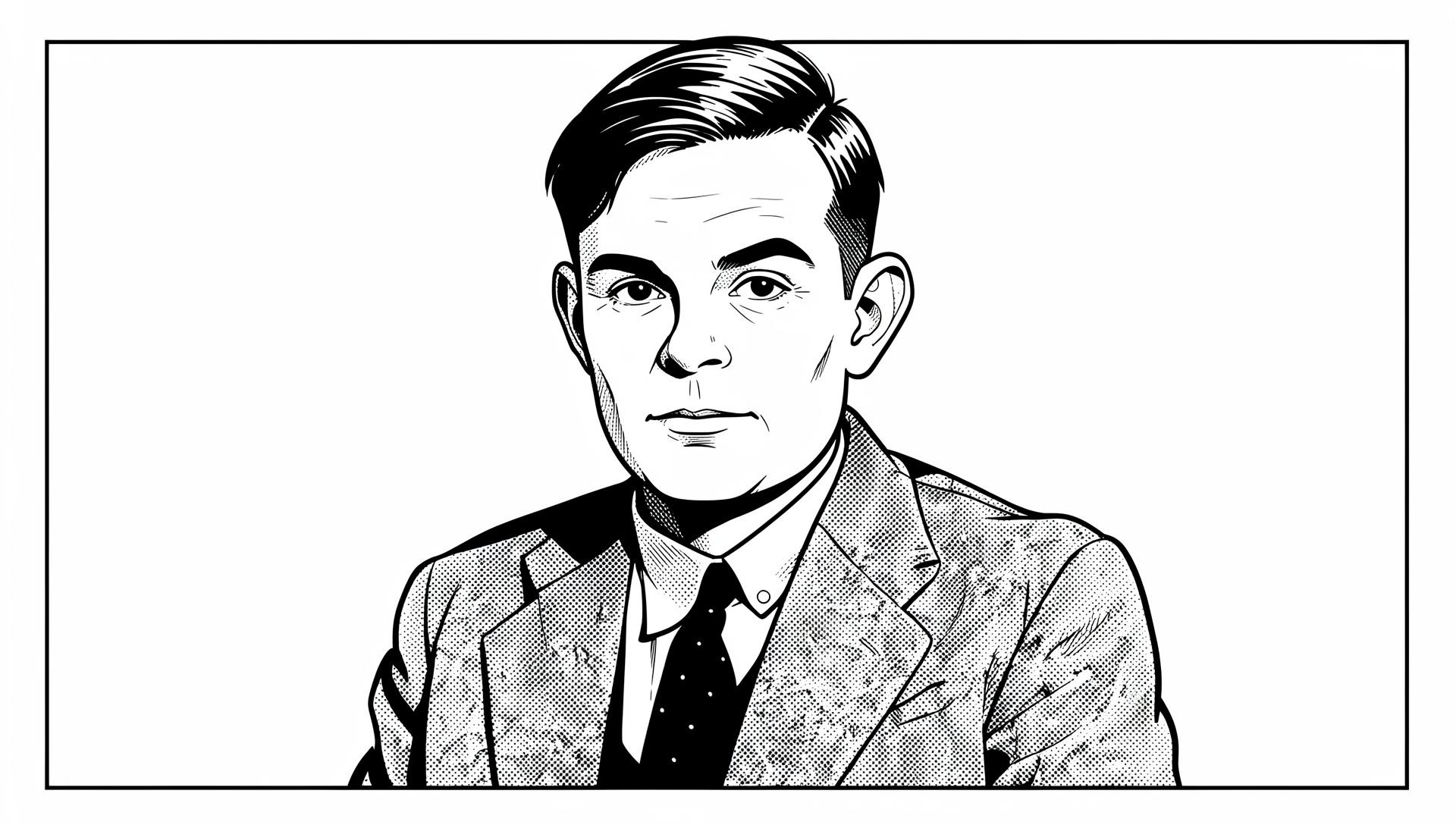
Alan Turing
Mathematician and Computer Scientist
University of Manchester
Alan Turing (1912–1954) did not build an artificial intelligence. What he did was more foundational: he defined the conceptual terrain on which artificial intelligence would later be built. His 1936 paper "On Computable Numbers" established the theoretical basis for the modern computer through the concept of the universal Turing machine — a device that could simulate any other computing device given a description of it. Fourteen years later, in "Computing Machinery and Intelligence" (1950), he proposed what he called the Imitation Game — now known as the Turing Test — as a way of operationalising the question "can machines think?" without having to resolve the underlying philosophical question.
The Turing Test has been criticised extensively, and justly so. It conflates the appearance of intelligence with intelligence itself, and Turing knew it — the paper engages objections at length. Its lasting contribution is not as a measure of machine intelligence but as a provocation: it forced the question onto the table. Turing's framing shapes how we still talk about AI.
Turing's war work at Bletchley Park — leading the cryptanalytic attack on the German Enigma cipher — had direct military and historical consequences. The techniques he developed for Bombe machine design were operational rather than theoretical.
In 1952, Turing was prosecuted for gross indecency under laws criminalising homosexual acts. He was subjected to chemical castration as a condition of avoiding imprisonment. He died in 1954, aged 41, of cyanide poisoning — the inquest ruled suicide. He received a posthumous royal pardon in 2013.
AICI regards Turing as the appropriate figure to begin any account of AI history: not because he built AI, but because he asked the right questions at the right moment, and paid a devastating personal price for who he was while doing it.